Showing posts with label Native American History and Culture. Show all posts

Saturday, November 27, 2010

Thanksgiving is Back

The snow vanished in only a few hours. The temperature rose, rain poured, and it looks now as is no snow flake ever fell on the hill. Of course, this helps commute and travelling and this is good news in this Thanksgiving week where so many families travel to gather around the traditional turkey.
Still I miss the snow. It brings so much light - important when the sky is so often overcast. Also, the snow generously transforms the somewhat neglected yards in harmonious immaculate spaces…
And here we are: this Thursday is Thanksgiving. There are documentaries on TV tracing the origin of this tradition. It actually started on the 19th century, when the country needed unity in the common respect of a celebration. A one-time event that took place at the 17th century – a meal shared between pilgrims and Natives from the Wampanoag tribe – provided the historical memory to root it down.
This painting below is from the beginning of the 20th century, and you see it often in those documentaries. I saw a copy for the first time at the home of one of Irvin’s brothers, and what struck me is the way the pilgrims are represented, welcoming the Natives with a kindness mixed with a bit of patronizing. The Natives are shy and sitting on the ground. The pilgrims offer them food. Actually, the Wampanoag taught the pilgrims how to survive by growing corn and squash. According to the letter documenting this shared meal, they also provided five deer.
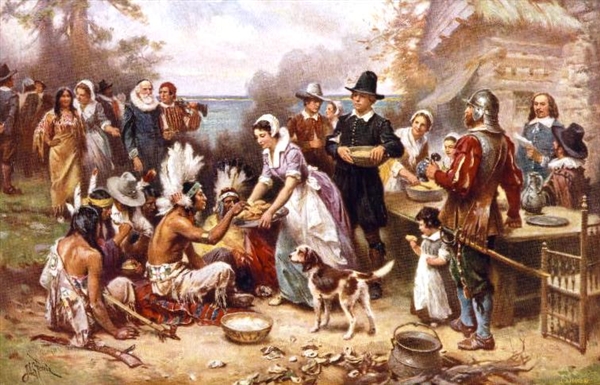
Some American citizens, Natives and non Natives don’t celebrate Thanksgiving. On Thursday morning, some news mentioned that Angelina Jolie purportedly was among them, refusing to “celebrate what the white settlers did to the native Indians, the domination of one culture over another”.
The fact is, the Native peoples I know, from our church or Irvin’s family, are well aware of the history of their country. But they enjoy this opportunity of a family reunion around great food. Like we do every year, we had a Thanksgiving potluck at church last Sunday. We had a full house! Sharing a meal and pondering gratitude do not mean turning away from the past. For our monthly “Dinner and a Movie” night of November, we watched the first episode of the PBS documentary “We Shall Remain”, telling about the story of the Wampanoag tribe and the first contacts with the first generations of Europeans. The episode title is “After the Mayflower” and it can be viewed online at the following link.

Friday, October 29, 2010

A memorial to commemorate and say thank you

For two years, Irvin and his siblings prepared this day honoring their Dad Larry Porter. They would have regular conference calls to discuss the list of gifts, the family members and friends to show appreciation to, the meal to plan for 150 guests… On the morning of that October 16th day, tension was perceptible when we started to lay table clothes on the round tables of this large room the Sheraton let us use, near the golf whose so vividly green lawns made such a contrast with the desert.

But everything went well, along with the joy of gathering and seeing each other again, except the powerpoint presentation that my sister-in-law Grace patiently put together and which was most reluctant to start. The big screen showed our pup Sitka (the background screen of our laptop) while Grace kept busy working on the settings of the computer.

Sylvia, daughter of one of Larry’s sisters (he was the younger of 10 children) spoke of the Pima traditions she knew of. She mentioned that available young men would race, and young women would run after them. If they could catch up with them, they were allowed to date. Sylvia suspected that her grandfather slowed down on purpose so that his wife-to-be could draw level with him.

As it is customary, the blankets were opened by Irvin and his brother Fred when they presented them and they then wrapped it on the person who would receive it.

This memorial also allowed us to see Bill again. Bill is Hopi, a tribe from the Northern plateau of Arizona. This tribe has kept most of its original culture. Bill and his sisters still fluently speak Hopi. He calls me “Me Wee”, which means “daughter in law”. Bill is the second husband of Eloise, Irvin’s mother, who passed away in 2006. He used to feel such jealousy toward Larry that he would not stand seeing pictures showing them together. At the end of Eloise’s life, he cared for her with great dedication and his feelings evolved. And here he was, travelling through Arizona to be part of a day dedicated to Larry that included many pictures of the past.

Eventually, a grave stone designed by Ron, one of Irvin’s brothers, was set up on Larry’s grave.

More pictures can be seen on the French version of this post: http://anne-cecilenews.blogspot.com/2010/10/un-memorial-pour-se-souvenir-et-dire.html

Monday, October 25, 2010

VAH KI CAMP MEETING

For more than a hundred years, Christians Pimas (most of them Presbyterians) have been gathering for several days in October for a serie of worships aimed at deepening their faith. Some of them camp out near the nearby Church, called Vah Ki (“old house” in Pima) and worship take place outdoor, under a large roof. By mid-October, the weather is still very warm in Arizona, but strong winds and thunderstorms often happen in this area which on the same latitude than Africa.
No less than 3 worships take place during the 4 days of the camp meeting. Some families don’t miss any of them! Irvin was invited to preach 5 times during the weekend. The worship services keep the memory of the revivals time. The sermon should always be at least 30 minutes, and an altar call follows. The choirs of the neighboring churches participate in those worships, singing in English or in Pima. Each worship service last about two hours and a meal for everybody follows.

Make sure you check the French version of this post that includes some pictures at http://anne-cecilenews.blogspot.com/2010/10/camp-meeting-vah-ki.html

Sunday, October 24, 2010

Calendar Sticks : not your ordinary History book

What is the best way to keep track of historical events when you don’t have a alphabet and written language yet ? Carving symbols is a good solution. The history of the Pima people has long been written on long sticks called “calendar sticks”.

Friday, October 22, 2010

The People of the River

Most Native American people are from several nations, and so is Irvin. His mom, Eloise, was Nez Perce, a tribe from central Idaho. His father was Pima (Akimel O’otham, people of the river) in Arizona. However, Natives can only be enrolled in one tribe. Irvin was born in Idaho but his siblings and he could not be enrolled in the Nez Perce tribe. Eloise’s mother was Norwegian. There was also a French Canadian ancestor on her father side. Eloise therefore could not transmit to her children the quarter Nez Perce blood required. They turned toward Arizona.

The Gila (pronounce ‘ila) River Indian Community was officially created in 1939. It is located on a reservation of 580 square miles South of Phoenix. This area has been inhabited with Akimel O’otham for more than 2000 years. For generations, Pimas practiced agriculture by using the abundant water coming from the Gila river, the most important affluent of the Colorado river. They would grow corn, beans, squashes, melons, citrus, cotton.

The Gold Rush toward California at the 19th century brought an important population in the region. The lines around the current reservation were drawn in 1853, following the banks of the Gila River. But the families that settled upstream started diverting more and more water and soon, its level became so low that it could not support the fields of the reservation. Desert spread. Some of the Natives moved toward East, near the Salt River, an affluent of the Gila, creating a new Pima community.

The fields surrounding the Gila River became desert. The government sent supplies – fat and low-quality food. The health of the Native has been impacted forever. Suddenly sedentary, using a completely different food, the obesity rate skyrocketed. Today the tribe still has the highest diabetes rate of the world.

But this nation is full of resources. Pimas worked little by little on new irrigation projects; cotton fields, citrus and squashes are now growing again on the reservation ground. Casinos were opened and thrived. The leaders of the tribe invest the profits with a long-term vision, foreseeing that those earnings could evaporate one day, like the Gila River did. They built hospitals and state of the arc dialyses centers.

They created hotels and resorts whose architecture fit harmoniously with the desert. The members of the tribe enjoy important discounts there. The Wild Horse Pass Sheraton has become our home away from home when we come to Phoenix.
The people of the River has shown remarkable adaptability to change and long-term vision.