Showing posts with label Bible and Commentaries. Show all posts

Sunday, December 24, 2017

Jean-Paul Sartre and the Nativity

We are in 1940, in Germany, in a camp of French prisoners. Among them, some priests asked Jean-Paul Sartre, who had been a prisoner with them for a few months, to write down a short meditation for Christmas’ Eve. Sartre, the atheist writer, accepted. And he offered to his companions those beautiful lines.

“You have the right to demand and see the Manger. Here it is. Here is the Virgin, here is Joseph, and here is the Child Jesus. The artist poured all his love in this drawing, maybe you will think he is naïve, but listen. You only need to close your eyes and listen to me, and I will share how I see them from inside me.
The Virgin is pale as she looks at the child. Worried wonderment is what should be painted on her face, a wonderment that only appeared once on a human face, because Christ is her child, the flesh of her flesh and the fruit of her womb. She carried him for nine months. She gave him her breast and her milk will become the blood of God. She holds him, and she says, “my baby”!
But sometimes she is taken aback, and she thinks “God is here” and she feels a religious fear growing for this mute God, for this child, because all mothers have been taken aback in such moments, by this fragment of their flesh that is their child, and they feel exiled as they face this new life that has been done with their lives and that is inhabited with foreign thoughts.
But none has been more cruelly and more quickly teared away than from this mother because He is God and He exceeds on all sides what she can imagine. And that’s a heavy trial for a mother to fear herself and her human condition in presence of her son. But I think there are other quick and smooth times where she feels that Christ is her son, her own baby, and he is God. She looks at him and she thinks “This God is my child! This divine flesh is my flesh, He was made from me, He has my eyes and his mouth is shaped like mine. He looks like me, He is God and He looks like me.”
And no woman ever had God for herself. A God very small that you can hold in your arms, a God you can cover with kisses, a warm God who smiles and breath, a God one can touch and who lives, and I would paint Marie in those moments if I was an artist, and I would try to convey the tender audacity and the shyness in her as she moves her finger to touch the soft small skin of this child God, as she feels his warm weight on her lap and as he smiles to her. So that’s for Jesus and for the Virgin Marie.
And Joseph. Joseph? I would not paint him. I would show a shadow in the back of the barn and bright eyes, because I don’t know what to say about Joseph. And Joseph himself is not sure what to say. He adores and is happy to adore. He feels in exile, a little. I think he grieves without admitting it. He grieves because he can see how much the woman he loves looks like God. How much she is already on God’s side. Because God came into the intimacy of this family. Joseph and Marie are separated forever by this fire of clarity, and all his life, I imagine, Joseph will be about learning to accept. Joseph himself does not know what to say about himself : he adores and is happy to adore.”
(From « Baronia or the Son of Thunder” a play written by Sartre about his time as a prisoner of war. This text is also included in « the Writings of Sartres” by M. Contat and M. Rybalka, NRF 1970)

Saturday, April 15, 2017

Good Friday: At the Beach with Peter

A Good Friday service took place yesterday near UPPC, at St Andrew’s Episcopal Church. Every year, the Pastor invites the neighborhood churches of all denominations to be part of the service. I got to be one of the three pastors who shared a 5-minute message. The theme was “A Witness in Dark Times”. We chose texts from the Gospel of John. Mine was Peter meeting Jesus on the beach after the resurrection. (John 21:15-19)
As I was gathering my thoughts about this message during my commute time, the song “Rock me Tender” came on… A love song. And the text I was working on was also about love.
Anyway, here it is.


At the Beach with Peter – a Good Friday 5-Minute Sermon

“Don’t you know? I have never been loved like this before”.
I heard this line from a song, an oldie “rock me gently” by Andy Kim, and those words[1] made me think of Jesus, Jesus dealing with Peter, dealing with us.

It is true for each of us. Don’t we know ? We have never been loved like this before.

We receive forgiveness and grace, and because we love the one that loves us so much, the one that loved us first, we become disciples and we become shepherds.
Feed my lambs. Take care of my sheep, said Jesus to Peter. May your care, may your food comes from the place where the love you have for me dwells.

Peter was a sort of spoke-person for the disciples, the first to speak up for better or worse. The first to identify Jesus as the Messiah, which led to those famous words “You are Peter and on that rock, I will build my church.”[2] Yet the next moment, Peter shushed Jesus. “No, Jesus, stop talking about you dying soon, it will not happen”. Jesus had to tell him to move away from him and called him Satan[3].

It is so like us. We will boldly proclaim that Jesus is the Messiah, and in the same breath, we are so very ready to know better than Jesus.

In the worse night of his life, Peter promised he would die rather than let anything happen to Jesus[4]. He meant it! When Jesus was arrested, he took a sword and was ready to fight[5]. If Jesus had let him fight, Peter would probably have been the first to die. Those soldiers were numerous and had come with heavy weapons[6].


Peter had the courage to follow those who arrested Jesus. Only two, Peter and the unnamed disciple made their way to the high priest court. All the others had run away in the night. It was dark and cold. This is where Peter tried to stay warm by a fire, was asked questions and denied being a disciple and even knowing Jesus[7].

Did Peter go to fish that morning, after Jesus’ death, because he felt he was not worthy anymore of being a disciple? We don’t know. But we read about Peter overjoyed to see Jesus and jumping off the boat to meet him faster. 

Jesus built a fire, like the one in the high-priest courtyard where Peter had stood.

Just like Peter had denied Jesus three times, Jesus asked him “Do you love me?” three times. Each time Peter declared “You know that I love you” and Jesus then commanded him to take care of his sheep.

During this Holy Week, UPPC has opened a prayer where all can come in and spend some time in meditation and prayer. There is a notebook where anyone is welcome to write comments.

Someone wrote “God, my heart is heavy. I feel like Peter as the rooster crooked. Help me to become more committed and faithful to my Lord and Savior!”

The comment is anonymous and I wanted to tell the person who wrote it “The story does not end with the rooster, remember! Remember that you are loved, right now, like you have never been loved before – just as you are.

This is what we learn here. Peter is our witness.

From the cold and dark place where the denial happened, Jesus took Peter to the bright morning of a breakfast on the beach. He showed him – and us – that the care Jesus wants us to demonstrate comes from the place where our love and gratitude dwell. Not our sense of duty. Not our need to please. Not our belief we should earn God’s favor. No. Our love and gratitude - that’s it.

Being a shepherd is hard work. Jesus told us so in the Gospel of John[8]. The shepherd cares for the sheep, he is known by them, he is ready to give his life for them. He takes them to lie in green pastures[9]. He can do all this because he knows he was never loved like this before.


From this love that came first, we can love, minister and witness through the darkness.

For each hour in the dark and cold, there is a warm time in the morning light of our Lord. We are delivered and the horizon is open. We are free to love and be loved. Free to serve.
Amen


[1] Song and Lyrics can be viewed on youtube https://www.youtube.com/watch?v=qIVX1_J_87s
[2] Matthew 16:18
[3] Matthew 16:23
[4] John 13:37
[5] John 18:10
[6] John 18:3
[7] John 18:18
[8] John 10
[9] Psalm 23
Picture by Jeroen Van Der Biezen http://saltandlighttv.org/blogfeed/getpost.php?id=52407&language=en

Thursday, February 25, 2016

Raphaël Picon

When news, good or tragic, hit us, we remember our surrounding with great precision. Where were we when a man walked on the moon… when we heard that lady Di had died… when we saw the images of 9/11 for the first time…

I was sitting with Irvin in a Starbuck in Orlando, in Florida, the day before we flew home. I was absentmindedly looking through facebook on my phone. On my French friends pages, I saw several times pictures of a young man with blond hair, smiling. Before I could even read the captions, I understood and felt my heart sink. Raphael Picon had died.


Raphael was a theologian and a pastor who had spent several years in the US with his family, pastor of an American church. He became a Professor and Dean at the faculté de theologie de Paris where I studied, arriving after my time there had ended. 
As a Dean, Raphael had quickly disentangled issues I had as I was trying to gather evidences of my credits. This allowed me to see my “Licence de theologie” validated as equivalent of a Master of Divinity, saving me from three additional years of seminary.  

I eventually met Raphael and his wife Cécile thanks to our common friend Olivier. Both of them worked with passion on the magazine Evangile & Liberté. We enjoyed several lunches and dinners together, meeting at the home of Olivier and Aurélie, the six of us abundantly talking about churches and seminaries, families, children and travels. Raphael and Cecile were fluent in English which helped Irvin to be part of the conversations.

A few weeks after our last encounter, Raphael found out that he had a brain tumor. Such a diagnosis could have created a total unraveling. Instead, he calmly started a treatment of daily chemo and radiotherapy while reading the drafts of his last book on Emerson “le sublime ordinaire” (daily or ordinary sublime). 

In a warm email, he thanked me for asking the prayer chains I belong to pray for him. One of his friends had slipped a prayer for him in the Western Wall in Jerusalem, he mentioned. Those initiatives meant a lot to him. But after those months of harsh treatments, another tumor was found and this time was not operable. From then on, news never ceased to be bad news. Until now.

I wished I could have gone to the memorial services and to the ceremonies at the Faculte de theologie. I thought a lot – I still do – about Cecile. We share the same first name, and years at the same high school although we did not know each other yet. Thanks to Olivier, I was able to read the testimony of his oldest son, who is 15, which ends that way:

“My father accepted his illness naturally as well as his upcoming death. And he did so for us, for the livings. He never expressed any concern about our future, the future of the four of us. He never gave us advice, because he trusted us, his “ordinary sublime”. He was convinced that life would resume if it had even ever stopped. He fully accepted suffering and death, to the point he led us in forgetting about it – and maybe forgetting it himself – in an ultimate and eternal gesture of life.”

What is a blessing? Irish poet John O’Donohue says it is “a circle of light drawn around a person… a gracious invocation where the human heart pleads with the divine heart. When a blessing is invoked, a window opens in eternal time.”

The life of Raphael, his books, his family and the memories he left behind are such blessings. The windows he left open for us have sowed and enriched our existence. 

Friday, January 22, 2016

The Voice of God

I was in a monastery for a retreat, north in the State of New York, shared one of the leaders of the conference. 

It was very cold. 

In the afternoon, I would make my way through layers and layers of snow to a chapel where I would meet with the monk who was my spiritual director during my stay. 

I could not hear the voice of God anymore. 

He showed me a heap of snow nearby the chapel. 

“If this was spring, you would see a river over here, he said. 

It is not frozen. 

It still runs, under those many feet of snow. 

In complete silence, I still hear it. 

It goes the same way with the voice of God…” 


Thursday, January 21, 2016

Sleep is a Prayer

The Lord gives sleep to those He loves, were we reminded. (Psalm 127:2). 
I think the Lord also loves the insomniac... 
We retired after this prayer by John of Dalyutha, an 8th c. mountain hermit in the region of modern Iraq:

"If you are tired and worn out
by your labors for your Lord, 
place your head upon His knee and rest awhile.
Recline upon his breast (John.13:23)
breathe in the fragrant spirit of life, 
and allow life to permeate your being.
Rest upon him, for he is a table of refreshment (Ps. 23:5)
that will serve you for the food of the divine Father."
Good night all!

Wednesday, January 20, 2016

Sweet Trinity


In today’s class at our Conference, led by BJ Woodworth (on the picture) we looked at this famous icon by Andrey Rublev (early 15th c.) representing the divine visitors that surprised Abraham at Mamre in Genesis 18. This icon has also been interpreted as a representation of the Trinity. 


The Son is in the middle, and the Father, on the right (with the green garment) turns his head toward him: he is sending the Son. The Son looks at Holy Spirit, with the gold garment. The Son is sending the Spirit (John 14). 
And the table between them, is the table of God, where we are invited (Ps. 23) to complete the circle. We, the creatures, are invited to the table with our Creator. We are invited to fellowship with God. From creatures, God sends us to become creators and bring his Kingdom into reality. 

Obviously, we had a Trinitarian dessert afterward: three raspberries, three drops of berry sauce, on the square table of a lemon tart. An enjoyable way to delight in Christian theology! 


God is in Florida

"In my heart of hearts God is closer to me than I am to myself." (St Augustin)

We are… in Florida, where Irvin and I will be part of a conference about “Making Room for God”. This is part of our continuous education – two weeks a year. We get to choose where to go – it is also possible to stay home and read the growing pile of theological books discovered and ordered as the year went by.

Those few days will allow a change in our daily routine; take time to dwell in the Scriptures. That will be a pause to attempt and discern the voice of God in our lives… while breathing the salted air of the ocean under the sun.

There are 75 of, Presbyterians pastors from the four corners of the continent for this conference. Being to meet and reconnect is one of the greatest aspects of this kind of gathering. We hope to find here the “substance”, the spiritual food that will sustain us throughout the year.

Pastor B.J Woodworth, one of the leaders of the conference, told us the following story as an introduction. A Rabbi was studying the Genesis book with his students. At each step of the creation, we read the famous words “And it was good”. Except… when humans were created.

Why? asked the Rabbi to his students. The answers were diverse and some very inventive but the Rabbi dismissed them. Eventually, he explained that the word “good” (tov) also means “complete, accomplished”. God did not create humans as completed beings. Each of us is meant to achieve God’s work in ourselves.


That afternoon, Irvin and I walked on the beach that seemed to never end. The wind reminded us that winter was here, but we took great pleasure in feeling the waves so close as the birds, seagulls, cormorants and pelicans dived in to capture fish.

That was, yes, tov. Good. 


Saturday, April 11, 2015

Holy Week, a Week Apart

Holy Week is an essential time in the life of a church. Each year, the same question comes up: how should we best present the last hours of the life of Christ, so that we remain faithful to the biblical message without repeating a routine, year after year? How do we celebrate those ancient events while making them current and relevant to the 21st century parishioners?

Thursday – Last Supper and Clean Hands

Thursday is Maundy Thursday – from latin “Mandatun” which means “commandment”, referring to the “new commandment” given by Christ during the last supper.

In the Gospel of John, in lieu of the command to eat the bread and drink the wine – representing the body and blood of Christ – we find Jesus insisting on washing the feet of his disciples. They are embarrassed. This task belonged to the least of the servants in a traditional household. Jesus  was teaching them an attitude of service toward each other that would be instrumental in bringing the Kingdom of God closer.

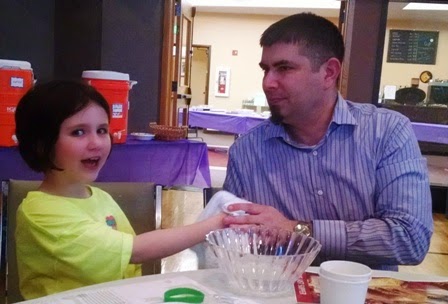
Irvin and I did not spend this evening together since CIF and UPPC both had planned a potluck dinner that night. There would also be a time of worship and communion. At UPPC, we also would wash each other – not feet, but hands. This was a suggestion that came from my experience at CIF. We did so a few years ago.

Washing feet was a tradition at the time of Jesus, where everyone had to walk their way to their destination on the dry and dusty paths of the Middle East. People would walk with simple sandals or with bare feet. Today, in our western world, feet don’t need a washing after we get to our destination. Our hands, however, are the ones requiring cleaning. They represent our service and our actions. They also express our desire of transparency and sincerity. Historically, we shake hands to demonstrate we are unarmed.  

I checked on what people were saying on that topic on Christian websites. I was surprise to find a controversy about it! Those who insisted on washing feet felt that doing otherwise was betraying the Scriptures. “Jesus did not wash the hands of his disciples! Let’s dare and follow his example rather than focusing on making parishioners more comfortable by not requiring they let go of their shoes!”
Sometimes, I feel we should also dare contextualize actions and traditions.


Friday – the Cross and the Gift of Freedom

Nine stations were put together in UPPC sanctuary. Each of the stations represented a step on Christ’s journey toward the cross on this Friday, from the garden of Gethsemane to Golgotha. At each station, participants were invited to reflect on the trials endured by Jesus and on their own path. This was a project that required an enormous amount of work, in particular for the team that physically put together each station. Lots of visitors came and appreciated this journey in the heart of Good Friday.  


That night was also Passover night. Irvin and I drove to Seattle to be part of the celebration with my Jewish family. As my aunt Diane mentioned, Passover takes place this year right in the middle of Holy week, and on a Friday, that is on Sabbath night. We praised together God the liberator with prayers in Hebrew, which is a delight for me and we dipped the Karpas (usually parsley) in little bowls of salt water. This is a reminder of that in midst of tears, we can also already taste hope and renewal.


We praise God who frees us and we are invited to become aware of the responsibility that now lays on us : we must use this freedom to free our neighbors. If they stay oppressed, we are not truly free either.

I admire the way the liturgy is waived throughout the meal, and how children become part of it, not simply observers, but actors. The youngest at the table asks the ritual questions, starting by “Why is this night different from all the other nights?”. Children are also tasked with looking for the Afikomen, a piece of matzah (flat bread) that has been hidden previously. This Afikomen will be the dessert.


But we had more than a piece of matzah for dessert. We enjoyed the fruits of the extraordinary talent of our friend Emma Notkine, whose lemon and pistaccio cake (a flour-less cake, of course) was a true work of art. This was high cuisine – and Emma is hardly in her early twenties!


Saturday – a pause (and for pastors : time to feverishly write their Easter sermons)
And since I was not preaching, it was a welcome pause for me.

Sunday – He is risen.

Three services that morning at UPPC, and for those who work there, a parking further away to make room for the visitors. A little girl in a pink dress from a fairy tale was baptized at one of the services and she admitted that she hoped that the bruise she had on her face (a confrontation with another child during recess that week) would disappear with the baptismal water. 

During the contemporary service, a rap in the middle of the opening song, not exactly my kind of music, but this one was superb and occasioned an ovation from the surprised and delighted crowd. 


And Pastor Aaron, with the same enthusiasm, preached three times about the way God reaches us best when we are in the ground, in the deepest hole, in a grave like Jesus was.

It was Easter.

Then the discreet ritual that follows Easter… Rest for exhausted pastors. 


Monday, February 23, 2015

Ash Wednesday from Backstage

A few days ago, we embarked for the journey that Lent represents – a time of introspection during which we prepare for Easter and the resurrection of Christ. It starts with worship, on the evening of Ash Wednesday where we receive a cross-shaped mark on our forehead drawn with ashes, symbol of mourning and sacrifice.


The word of Lent in French is Carême , from the Latin Quadragesima, meaning 40th, for the 40 days (not including Sundays) of the season. In English, Lent points toward spring, the time where days lengthen.

At UPPC, last Wednesday, worship was at 7:00 PM. The preparations reminded me of my first American Ash Wednesday, in Dubuque, Iowa where I lived my first two American years. The seminary student in charge of providing the ashes got worried because they were too light-colored. He had an idea which showed genius: he would add some toner – ink meant for printers. He had time later to confirm that the color was perfect: the dark shade of the cross on the forehead of the participants of the worship tenaciously resisted being washed out from their face for several days.

As the service closed, I was by the side of Aaron and Taeler, each with our bowl of ashes. It was moving to touch the foreheads of the participants, being in this close contact with them, sometimes pushing away a strand of hair... 

This was the time where we are reminded of our mortality with the sentence “Remember you were dust – and to dust you shall return”. This was so unusual to say so to each of them, particularly the youngest ones. And yet true, and strangely peaceful.

The weirdest thought came through my mind suddenly – should I say “you will return” or “you shall return”? Memories from my English grammar class seem to indicate that “shall” should be used only for the first person, singular and plural – in other words, “I” and “we”. Taeler and Aaron were not close enough for me to hear what they were saying. 

I pushed the thought away. I must have said both. I think both were okay…

The service ended in silence. 

Wednesday, February 18, 2015

The Legendary and the Mundane, or Wandering on Facebook

I am not on Instagramm, Pinterest or Twitter. Why? Because I am already addicted to Facebook and I don’t want to add any other temptations.

Obviously, Facebook is not perfect. If we don’t pay attention, we can really  get hypnotized while looking at our home page, going without any transition from tragedies of the world to recipes our friends made last night. 

And let’s be honest about it : since there is always something new to check on, Facebook is a top tool for any expert in procrastination.

But Facebook is also irreplaceable. Let’s take an example. If you happen to be a French person who grew up in the Paris suburbs, studied theology in Paris then in Dubuque, Iowa then got quickly ordained (12 short years later…) Facebook will allow you to stay connected to your French and American Friends, from childhood, high school, French home church in Cergy, friends from two seminaries - and you can also connect with their friends, many of them being interesting people with good reading that they comment. You also have the opportunity to chat by instant messaging.

Facebook also provides pictures and videos of delightful animals – an important addition to any normal day. I just discovered the FB page of a refuge for big cats in Florida. They post gorgeous pictures of the animals. (Big Cat Rescue)


Many good newspapers and Medias have pages on FB. So in one journey through your home page, you have the opportunity to go through many articles from French and American magazines. Your friends share their own discoveries.

Today for instance, thanks to Michel Jas, Facebook friend and French pastor, I read a long article on ISIS, published by the Atlantic. Its author, Graeme, makes clear that this movement is founded on a belief system coming from a medieval interpretation of the Koran. It explains a lot – and particularly why so many feel compelled to join them and how to stop them.   (Graeme Wood, What Isis Really Wants, http://www.theatlantic.com/features/archive/2015/02/what-isis-really-wants/384980/ )

And I also read the poignant statement written by Bishop Angeolos, representing the Egyptian Coptic church in Great Britain, after the brutal death of Coptic Christians in Lybia. I was touched by his words “In the midst of this sorrow however, we must continue to dig deeper for the joy that comes from an understanding that this life is but a “vapor that appears for a little time and then vanishes away” (James 4:14)

Thanks to Facebook, I can also be part of conversations with groups such as “RevGalBlogPals” (women pastors who share they experience and liturgies) or “Things They Didn’t Teach Us in Seminary!” (swap of prayers and also comments on thorny situations, with suggestions and supports). I found on Facebook the work of Rev. Steven Charleston, Retired Episcopalian Pastor from the Choctaw tribe, who writes daily beautiful prayers. I read this one during the worship at UPPC last Sunday.


"We are never outside the reach of prayer. No matter who we are, no matter what we do, we are always within the circle of someone's prayer. We live each day in this field of prayer. We sleep within its embrace; we rise within its blessing.

Somewhere, everyday, someone of some faith is praying in a way that includes us. They are asking the holy, by whatever name they know, to have mercy, to heal, to protect others. We walk within that prayer without even knowing it, without ever recognizing its source in the person who prayed it. In the same way, our own prayers reach the most distant stranger, until none of us are ever beyond the hope we share."

So that’s the typical stroll on Facebook : words that bring a larger understanding of the world, others who touch your heart and invite you to look up to Heaven, with a few stops to hear from your childhood friends and get cozy with a tiger. That’s not too bad of a journey…


Sunday, January 4, 2015

How Not to Be Perfect

It is one thing to accept to make mistakes, like Gaiman engages us to do (see below). 

But how does one overcome the determination to succeed at the first try in a flawless way – or else abandon it all? If we open our Bible, even Jesus seems to push us toward being a perfectionist.

“Be perfect, therefore, as your heavenly Father is perfect”. (Matthew 5:48, NIV)

If the goal is matching God’s perfection, everything is unattainable. How not to feel like the wings of our audacity have been cut short, as well as any enthusiasm – a word that actually means ‘divinely inspired’?

But Jesus’ perfection is not ours. The Greek word translated by “perfect” is τέλειος (teleios) which means “wholeness, maturity”. 

This is not about being flawless but complete, accomplished. We find the same idea in words derived from Latin such as integral or integrity.

This integrity, the fullness of our being, is the goal. And one can reach it by living fully and completely. 


Wednesday, December 31, 2014

Angels, cakes and divine presence

Rev. Lynn Longfield, a friend I look up to, accepted to preach during the ordination service. When I was working at the Presbytery, Lynn was the Presbyter, in other words the Pastor of the Pastors.

Lynn preached on Elijah’s journey, supported by God’s angels through discouragement and despair (1 Kings 19). This is one of my favorite biblical tests. 

An angel supports Elijah with fresh water and cakes baked on hot stones. Eventually, God comes close to Elijah, as a “gentle whisper” or “a still small  voice” (depending on the translations) so they can talk.


The paradox, said Lynn, is that “when God speaks to us in the silence of our own hearts, in that still voice of mysterious wonder, there comes also a deeper revelation that we are not alone, and, in fact, never have been."

The important is to listen. Lynn mentioned that she was given a plaque that read “silence and listen have the same letters. Coincidence?”

God walks by our side in many ways, concluded Lynn. Sometimes, God sends us angels that provide us with hot cakes and fresh water. The community around us is also the witness of God’s love.
It was never truer as on my ordination day. 

Tuesday, August 5, 2014

After the benediction

Last Sunday, I had the pleasure to lead worship at Church of the Indian Fellowship. Irvin was at Fort Worth, Texas where he participated at the multicultural conference of the PC(USA). I get to fill in for him when he is out of town.

Before the benediction, I often quote those verses from Philippians 4:5-8

 “Rejoice in the Lord always. I will say it again: Rejoice!  Let your gentleness be evident to all. The Lord is near.  Do not be anxious about anything, but in every situation, by prayer and petition, with thanksgiving, present your requests to God.  And the peace of God, which transcends all understanding, will guard your hearts and your minds in Christ Jesus.”

Then the benediction follows, that I keep simple.

“May the blessing of God almighty,
The Father, the Son and the Holy Spirit
Remain with you always.”

Irvin likes the benediction from Numbers (6 :25)

“The LORD bless you
       and keep you;
the LORD make his face shine upon you
       and be gracious to you;
the LORD turn his face toward you
       and give you peace."

Sometimes, he adds this Cherokee blessing :

“May the warm wind of heaven
blow softly upon you
And the creator make sunrise in your heart.”

After the benediction, I walk briskly toward the door of the church, while the assemble sings the responsive hymn.

The first time I saw a pastor do that was soon after I made it to the US. I remember my confusion when I saw the pastor leave the pulpit so fast. “Where is he going ? Leaving already?”

I found out soon that most pastors do it. They are not leaving, obviously – they go to the door to make sure they can shake the hand of each parishioner before they leave or go get a cup of coffee in the Fellowship hall.

“It is an intensely concentrated time of interaction” writes Martin Copenhaver[1], describing how his parishioners update him on their life in that short face-to-face moment, or react to his sermon, appreciative or perplex, rarely sarcastic.

He remembers though that soon after his ordination, a man told him with a smile “You know, Martin, every sermon seems better than the next one”. Martin comments “He was in his car and driving away before I realized what he had said”.

When in France, I would stay around the pulpit and gather my papers after leading worship. Some people would come up to me and we would talk. Others would chat with each other and disperse. It felt more spontaneous.

On the other hand, I appreciate having this opportunity to greet each person who came to join us, whether I have known them for years or am just meeting them. They have listened to me for more than an hour. It is my time to hear them – and I enjoy this opportunity.

Friends from French churches: so now you know. If the American pastor quickly moves to the door at the end of worship, he is not fleeing away or rushing to the bathroom. No, he just wants to make sure he will be able to shake your hand.
You heard his benediction. Now is his time to receive yours.

Irvin at the door of Church of the Indian Fellowship


[1] This Odd and Wondrous Calling, Eedermans Publishing, Grand Rapids, Michigan/Cambridge UK, 2009, p.11